Our teardown machine's best feature is the word Unknown.
A machine we built reads a business from the outside before our first call. What it found in three real companies, and why it admits what it can't see.
 JD Worcester6 min read
Updated

On this page
A report that says "I don't know" earns more trust than one that is confidently wrong. So we built one that says it, often.
What a teardown is
Before a first conversation with an owner, we want to know roughly where their week goes. We mean what their website, their Google listing and their reviews actually show, what that suggests about the work happening behind them, and what we would need to ask to know for sure, rather than a guess dressed up as a number.
A sharp person can do that in an afternoon. We built a machine to do the first draft, so the afternoon goes into the conversation instead.
How it works
You paste a website and press Start. It reads what any customer could read: up to 30 pages of the site, the Google Business listing, and the newest Google reviews. A small model pulls out the facts. A larger one matches them against a library of plays for the trade, the repetitive jobs we know how to automate, each with a range of hours it usually takes.
Then it argues with itself. A skeptic pass attacks every number in the draft. On the harder runs a contrarian pass argues the opposite case. The draft goes back and forth until what is left can survive an owner who knows their business better than we ever will.
A few rules are not negotiable:
- Every number carries a label. Measured if we saw it. Industry average if someone else published it, with the source. Estimated if we worked it out, with the arithmetic. Assumed if we had to pick a number to keep going, and it says so. Unknown if nobody has measured it.
- Hours have a ceiling. It cannot claim more time saved than a business of that size plausibly has to give.
- No revenue without evidence. If no published figure ties a fix to booked jobs, the revenue line reads $0, not a guess. Where there is evidence, no single change may add more than a fifth of the business’s revenue, and all of them together are held to 30%.
- It has to name its weakest link. Every report leads with the one assumption most likely to be wrong.
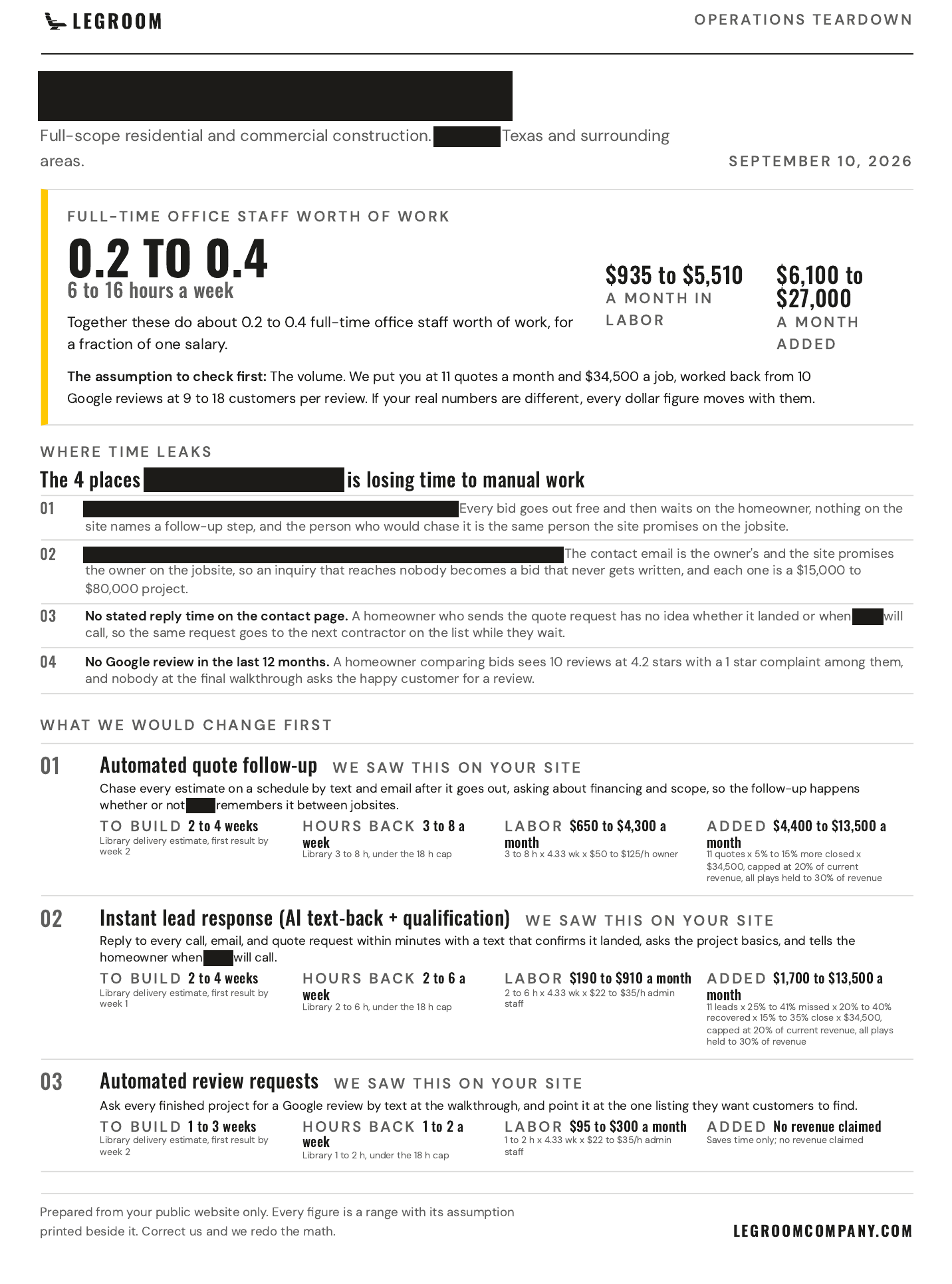
What comes out is one page. Where the time leaks, in the business’s own words where we have them. What we would change first, each with the time to build, the hours back, the labor and the revenue, and the arithmetic printed beside every figure. At the top, the assumption to check first.
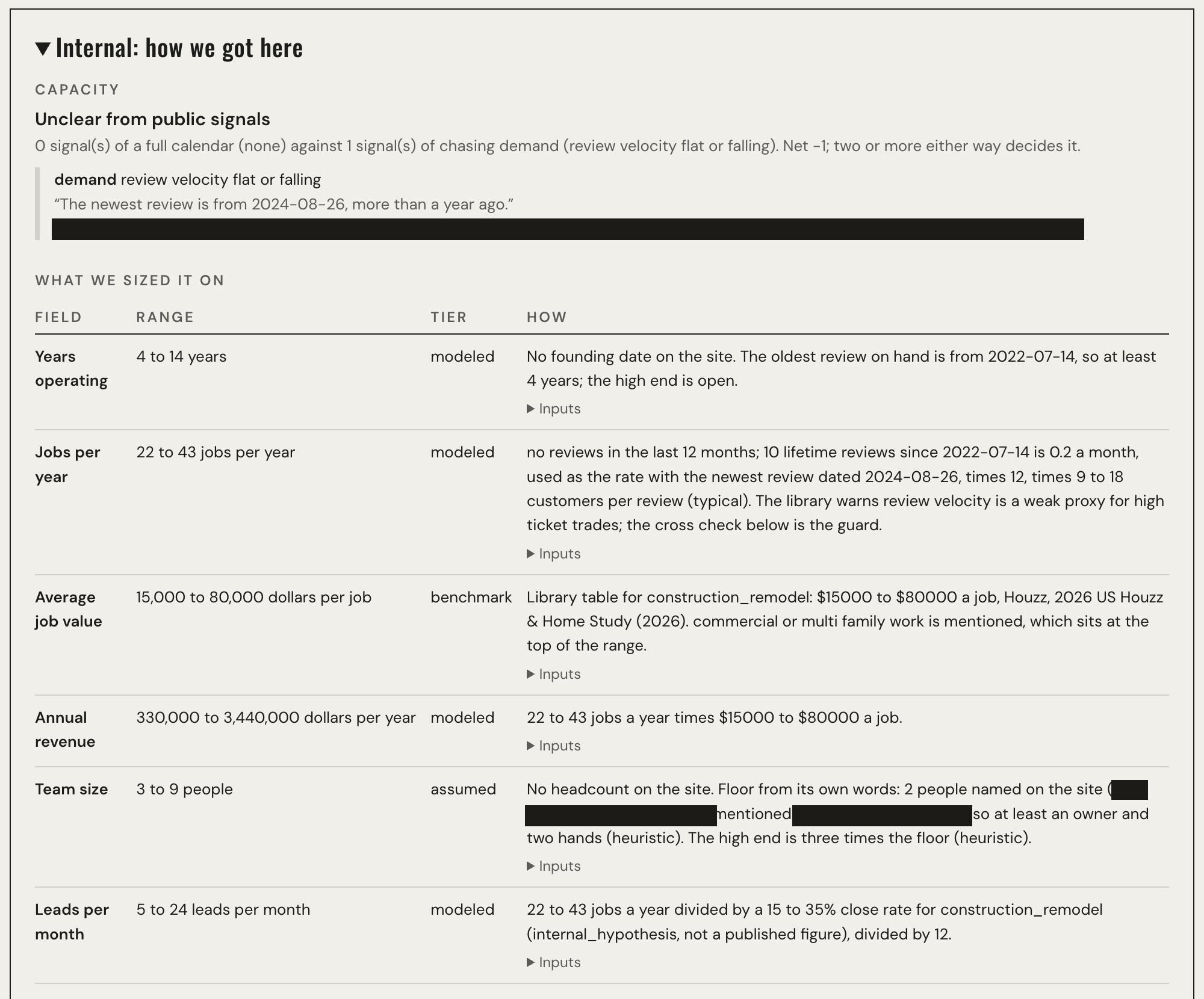
Behind it sits a page only we see. It shows how the business was sized, field by field: years operating, jobs a year, job value, revenue, team, leads. Each carries its label and the inputs it came from. When a number looks wrong on the call, this is where we find out why.
$16 to $29
1 of 3
What it found
We ran it on three real companies in September. None of them asked us to, so they stay unnamed here.
A large heating and cooling company in the Northwest. Thousands of Google reviews at nearly five stars, dozens of new ones every month, and a site that promises service 24 hours a day. By any measure this business is doing well, and the machine said so. The only play it could stand behind was drafting replies to reviews, since the owner answered 45% of the newest 400. Worth under two hours a week, and $0 in revenue by its own rule.
Then it marked its own report inconclusive. It had read one page of a large company’s site, it had taken the 24 hour claim at its word without calling, and it could not see what software ran the office. Its verdict, in its own words: “fatal for a claim and fine for call prep.”
What it handed us instead was three things worth saying on a call: a spring promotion still running on the page in September, months past its own expiry date, a two star review from a customer left waiting on a manager’s callback, and half of all new reviews with no reply.
A remodeling contractor near Dallas. The owner works the job sites and the contact email is his. No stated reply time, no online booking, a one star review from a customer who could not get a response, and no new Google reviews in over a year. The machine’s headline said 6 to 16 hours a week. Its own working underneath said 2 to 4, and it flagged its weakest link plainly: everything rested on ten reviews.
It also found two off-topic blog posts about gambling on the contractor’s website. A homeowner researching a remodel can find them too. That one costs nothing to fix.
A long-running railing fabricator in the Northwest. Its quote form already asks for every measurement an estimate needs, and its pricing rules are published right on the site. The inputs for an instant draft estimate are sitting there unused, so each quote is most likely rebuilt by hand. The machine put that at 2 to 6 hours a week. It also found a low-rated Google listing under the company’s name with no reply, which a buyer comparing fabricators may see before they ever fill out the form.
What it can’t do
It can’t call the business or see the software that runs the office. It doesn’t know whether the owner wants to grow or just get home by six.
That is why every Unknown in a report turns into a question for the call. “I have you at 11 quotes a month. Is that close?” lands very differently from a headline number. The machine’s top estimate for the remodeler was $27,000 a month in added revenue. We would never lead with it. The owner is the world’s leading expert on their own business. If they spot one number they know is wrong, the rest of the report stops mattering.
So the machine writes the first draft, and a person reads it as a skeptic before anyone else does. Every claim we can’t defend gets cut or labeled Unknown.
After the call, the owner’s answers go into the run: the numbers we didn’t have, in their words, and a verdict on every play, confirmed, corrected or killed. A killed play is the most useful thing an owner can tell us, and the next teardown starts from it.
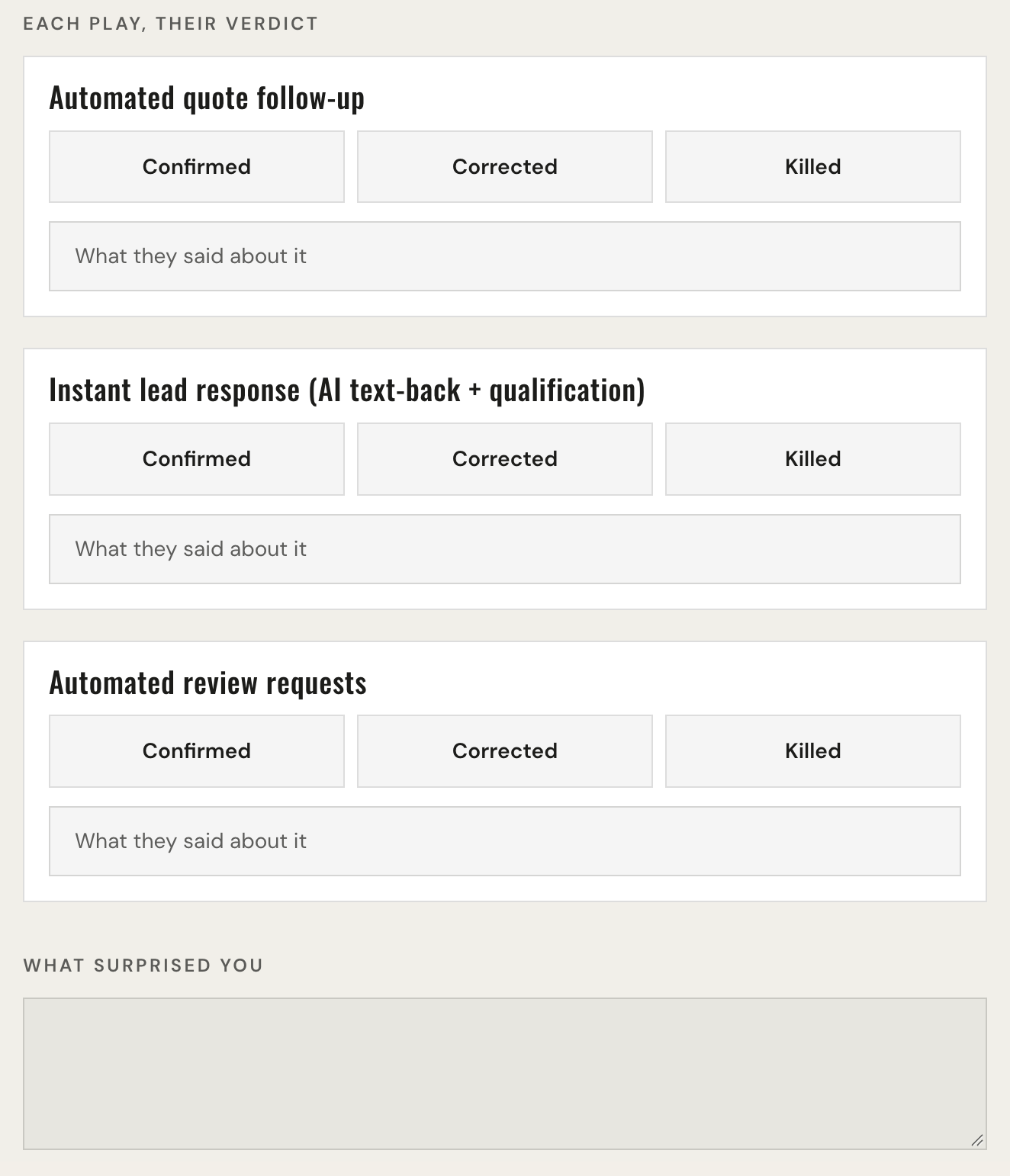
A one-page version of that report, unknowns and all, is what you keep from a free breakdown.
One example
To find out whether the machine would invent numbers when it had nothing to stand on, we ran a test. We handed it the wrong playbook on purpose: the one written for lawyers and accountants, pointed at a construction company.
It refused. Every play in that playbook was built for another trade, so it priced none of them. No hours, no dollars. It listed what it could see on the contractor's site, called the result a list of questions rather than a case, and asked to be run again with the right playbook and the Google reviews. That refusal is the result we were hoping for.