National press was sending people to a website that turned them away. We rebuilt it for free.
A Mariners fan, a Channel 5 video, and a website that turned people away. How our company rebuilt Buried Under the Blue's site at no cost, and why.
 JD Worcester4 min read
Updated

On this page
I’m a lifelong baseball fan and a Dodger hater. Mostly because I’m a Mariners fan and have suffered precisely the opposite experience. This is the story of how our company spent a summer working for the families under their stadium.
The short answer
Buried Under the Blue is a descendant-led nonprofit seeking justice for the families removed from Chavez Ravine to make way for Dodger Stadium. Their story was reaching national outlets, but their website turned the people that coverage sent away. We rebuilt it for free and handed every key back to them.
At a glance
| Organization | Buried Under the Blue |
|---|---|
| Type | 501(c)(3) nonprofit, Los Angeles |
| What we built | A new eight-page site: donations, petition, merch, a public archive and a press library |
| Their cost | $0, through Legroom Cares |
| Timeline | July to September 2026 |
| Who owns it | They do. Their account, their domain, their plan |
| Live at | buriedundertheblue.com |
- Organization
- Buried Under the Blue
- What we built
- A new eight-page site: donations, petition, merch, a public archive and a press library
- Their cost
- $0, through Legroom Cares
- Timeline
- July to September 2026
- Who owns it
- They do. Their account, their domain, their plan
- Live at
- buriedundertheblue.com
How I found them
One evening I was on the couch and a new Channel 5 video came up. Andrew Callaghan is my favorite creator, and he’s from my hometown, Seattle. This one was filmed at the Dodgers’ World Series celebration, and it has put Buried Under the Blue in front of nearly a million views.

By the end of it I was incensed. I went looking for more, the way you do. The first stop was the Buried Under the Blue website, and it was a monstrosity: a cut-off logo, a row of tiny buttons, and a big blue void where the page should tell you who these people are and what they want. The three things a new supporter shows up to do, donate, sign the petition, learn the history, were hard to find or didn’t work on a phone.
I had walked up to a locked door. Nearly a million people would end up watching that video, and some of them were going to walk up to the same one.
So we offered to rebuild it at no charge.
The story under the stadium
In the 1950s, Los Angeles cleared three Mexican American neighborhoods in Chavez Ravine: Palo Verde, La Loma and Bishop. The city said it was for public housing. The housing never came, and the land went to baseball instead.
- 1951 to 1952The city's housing authority buys and condemns homes in Chavez Ravine for a public housing project, Elysian Park Heights.
- 1953Public housing loses a city election. The project is canceled.
- 1957The city council approves a contract handing the land to the Dodgers.
- 1958Voters uphold the deal in a referendum.
- 1959Sheriff's deputies carry the last residents out as news cameras film it.
- 1962Dodger Stadium opens.
- 2024AB 1950, a bill to compensate the families, passes the Legislature. The governor vetoes it.
- 2026Buried Under the Blue launches its new site.
The engineering is its own story. To fit a ballpark into the ravine, crews cut the tops off the ridges and pushed the earth into the hollows between them, about eight million cubic yards of it, until the hill became a set of terraces. This reel is the clearest short version we have found.
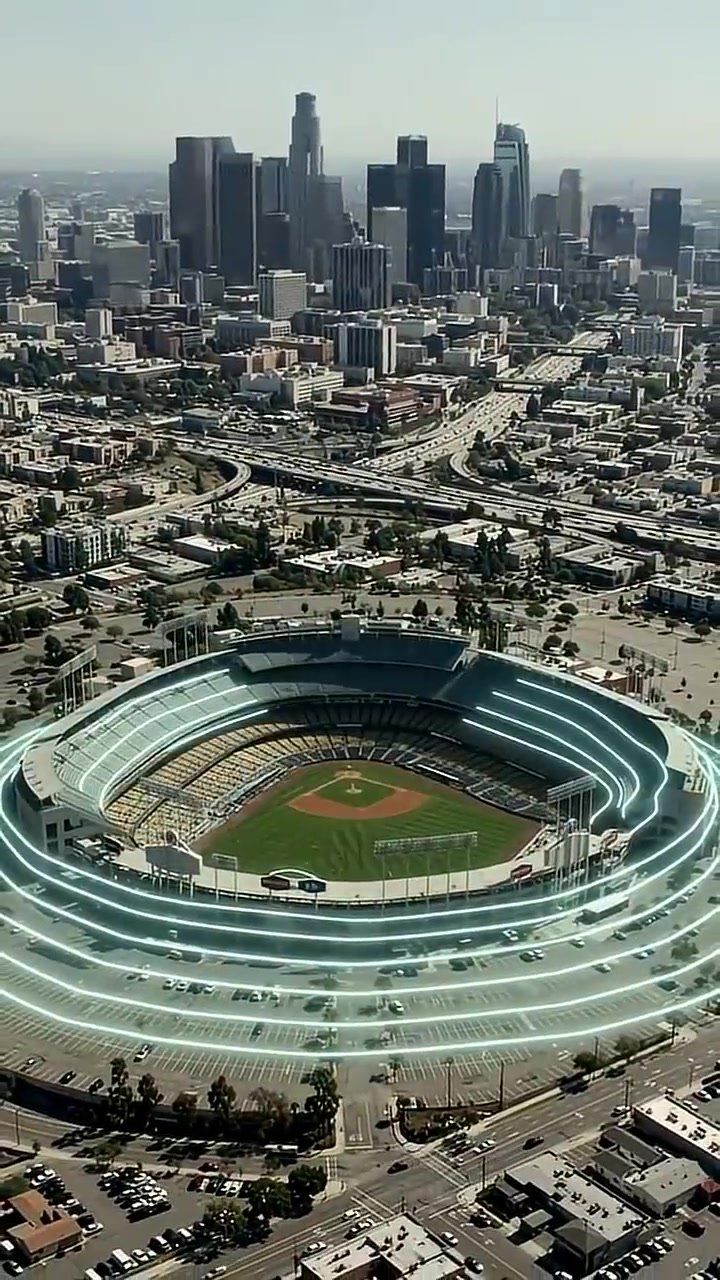
Transcript
- 0:00 Dodger Stadium is sitting on a hill that's missing its top.
- 0:03 Old maps put a peak right here, 726 feet.
- 0:07 Today, the top 150 feet is just gone.
- 0:11 So where did it go?
- 0:13 Split the stadium open, and you'll find out.
- 0:16 Before the ballpark, this was Chavez Ravine,
- 0:19 Palo Verde, La Loma, and Bishop.
- 0:22 Palo Verde even had its own elementary school.
- 0:24 The city cleared them out for a housing project
- 0:26 in the early fifties, then never built it.
- 0:29 And the ground was wild, steep ridges and deep ravines,
- 0:33 right where the field had to go.
- 0:34 So engineers sliced the tops off the ridges,
- 0:37 as deep as 150 feet.
- 0:40 Here's the trick, a lot of that dirt never left.
- 0:43 It went straight into the ravines next door,
- 0:45 packed in layer by layer,
- 0:47 eight million cubic yards of earth.
- 0:50 More than two great pyramids
- 0:52 shuffled around one hillside.
- 0:54 Peaks down, ravines up,
- 0:56 and the hill became a giant staircase,
- 0:58 stepping down to a bowl carved into its face.
- 1:01 That staircase is the secret.
- 1:04 The stadium doesn't sit on the ground.
- 1:06 It's built into five levels of it.
- 1:08 21 parking lots, terraced at five heights,
- 1:11 each one lined up with its own level of seats.
- 1:14 Park up top, and you walk in practically level,
- 1:17 onto the upper deck, the field way down below.
- 1:20 They even planted each lot's flowers in its ticket color,
- 1:23 so you could find your car.
- 1:25 At most ballparks, the upper deck means ramps and stairs.
- 1:29 Here, the hill did the climbing for you.
- 1:32 The bulldozers started in September 1959.
- 1:35 On April 10th, 1962, 52,000 fans walked in.
- 1:40 So Dodger Stadium isn't built on a hill,
- 1:43 it's built out of one.
It gives the three neighborhoods about ten seconds. Buried Under the Blue has spent years on them.
Buried Under the Blue was founded by descendants of those families, including Melissa Arechiga, Jeannie Arechiga and Vicente Montalvo. They keep the history alive through oral histories, school visits and a public archive, and they are asking the Dodgers for what they say is owed: a meeting with the families, a public apology, reparations for displaced homeowners and renters, community centers, and a permanent monument.
Every story that ran sent people looking for them. The website turned them away.
People were paying attention
I was years late to this.
The New York Times covered them in 2023 and again in 2024. The Los Angeles Times, NBC News, ABC7 and L.A. TACO told the story too, and FOX 11 put it on air. Every one of those pieces ended the same way for a reader who went looking: a search, then the same locked door.
Before and after
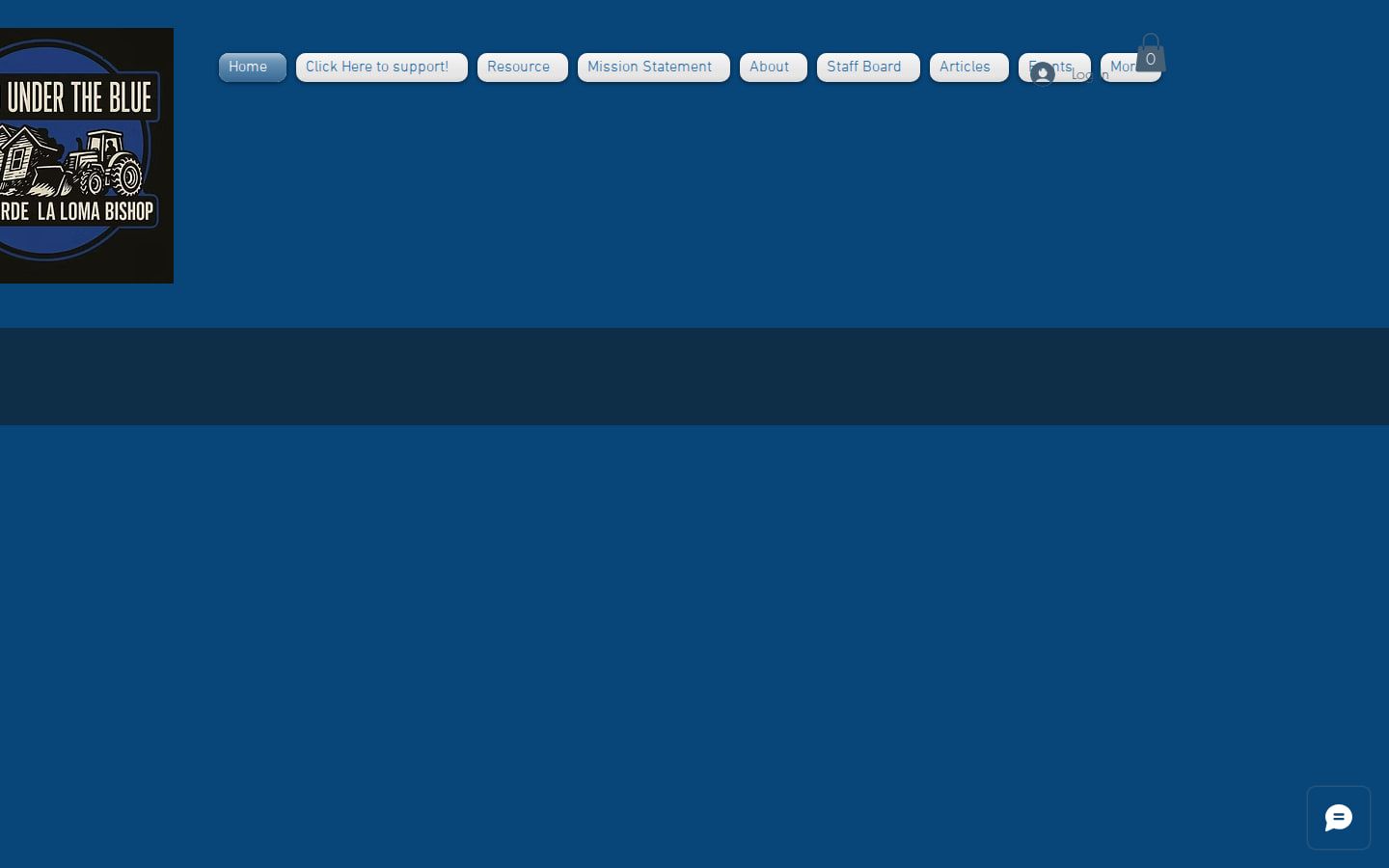
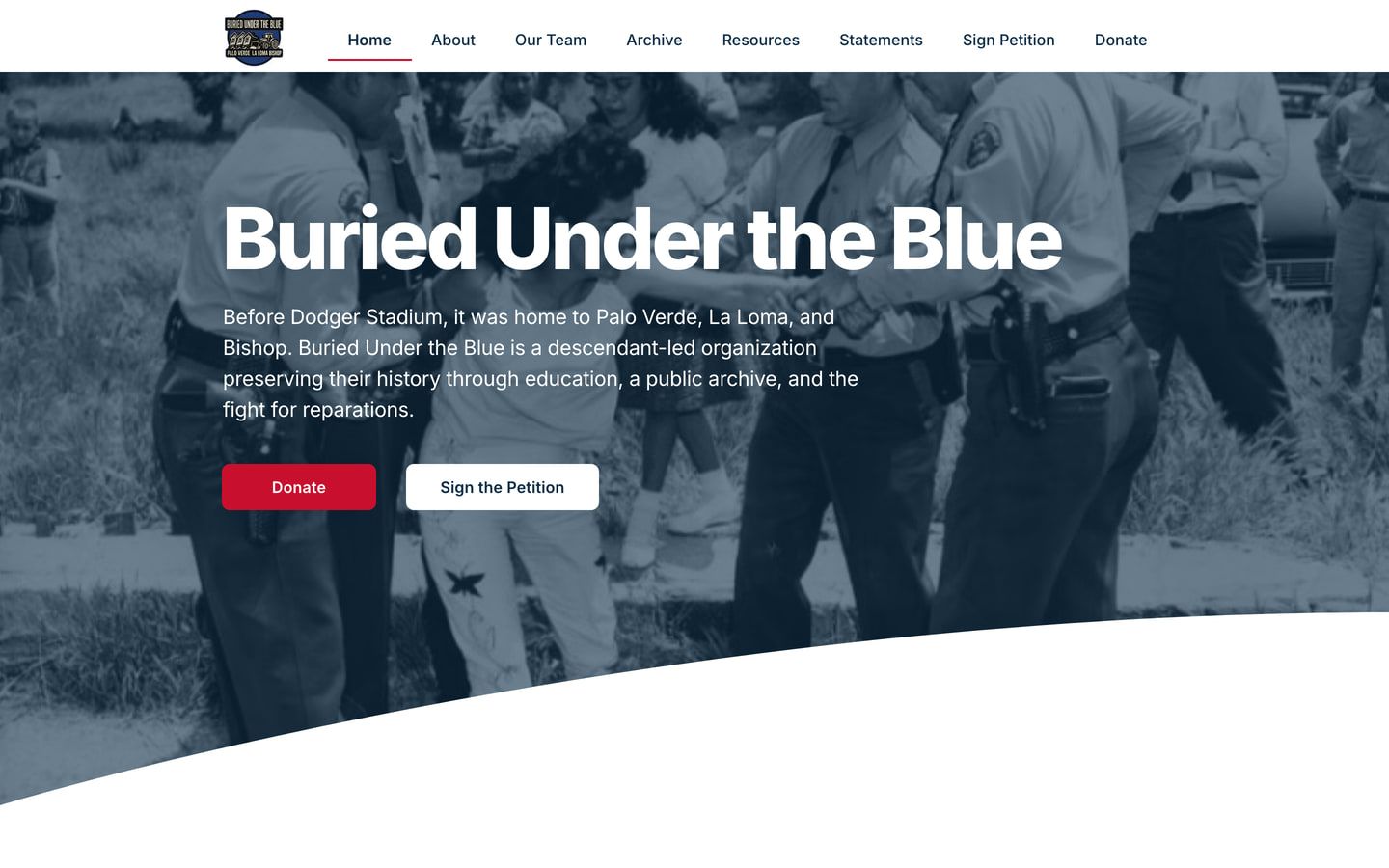
What we built
- A homepage that says who they are. One line, then the three things a visitor came to do: donate, sign, learn.
- Donations that work on a phone, including the $25 “Displacers” shirt.
- The petition, one tap from every page.
- A living archive of photos, oral histories, documents, maps and legal research.
- A press library. Eleven news stories, plus the podcasts, video and academic writing, in one place a reporter or a teacher can cite.
- A clean handoff. The site lives in their account, on their plan, at their domain. There are no Legroom logins and nothing to pay us, ever.
1.2M
7,679
$0
People were already showing up, which means demand was never the problem. The site turned them around at the door, and that part is fixed now. Whether donations, signatures and the archive grow from here is the real test, and for the first time there is a site that can pass or fail it.
If you’ve read this far, sign the petition. It takes a minute, and it is the one thing they are asking of you.
Why we do this
Most of what Legroom does is find the repetitive work eating a small business’s week and build the system that takes it off their plate. Some groups doing real good can’t pay for that, and shouldn’t have to. Buried Under the Blue was already doing the hard part, the work in the community. The website was in the way, so we fixed it.
That’s Legroom Cares. Know an organization that needs the same? Nominate them.
Nominate an organizationSources
- The Land Beneath This Stadium Once Was Theirs. They Want It Back.
- Bill Seeks Reparations for Families Displaced From Site of Dodger Stadium
- Chavez Ravine
- Bill seeks reparations for Chavez Ravine families
- Response to Governor's veto of AB 1950
- Remembering the communities buried under center field
- Los Angeles Considers Reparations for Families Forced off Land Where Dodger Stadium Stands
- Proposal Would Grant Reparations for Families Forced Off Land Eventually Used for Dodger Stadium
- Latino Fans and the History of Dodger Stadium
- Gustavo Arellano on Dodger Stadium: Dark Moment in Latino History
- LA Dodgers Victory Celebration
- Justice & Reparations for Palo Verde, La Loma & Bishop
- Dodger Stadium and the Battle of Chavez Ravine
- Dodger Stadium (Los Angeles)
- Press and resources